
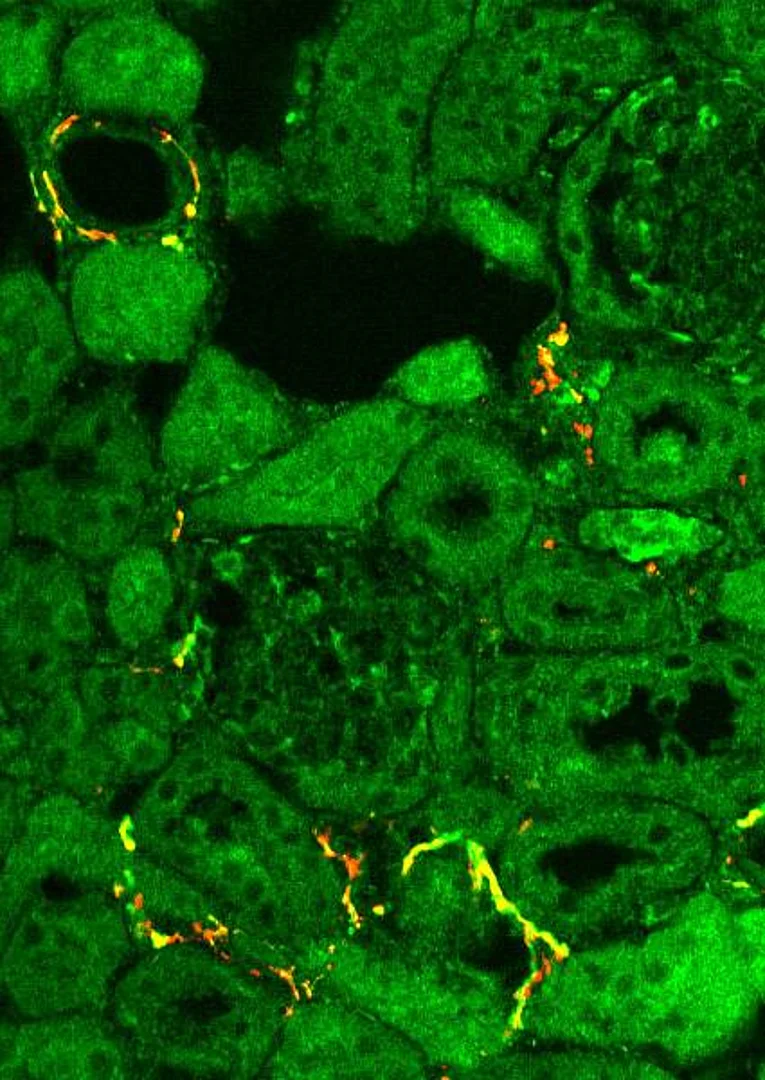
Experimental Renal Innervation
The research group pursues a combined experimental approach. On the one hand, electrophysiological investigations are performed in cultured neurons of the autonomic nervous system whose axons innervate the kidney in vivo, in order to characterize functional properties at the cellular level. On the other hand, in vivo neurophysiological experiments are carried out with direct recordings from autonomic renal nerve fibers to elucidate the significance of renal innervation for kidney function and cardiovascular regulation at the whole-organism level. In addition, we examine whether the functional properties of renal afferent nerves are reflected in specific transcriptomic signatures that demonstrate their specialized role in the regulation of sympathetic nerve activity — in accordance with our previous electrophysiological and neurophysiological findings.
The autonomic innervation of the kidney influences renal function in multiple ways and is also capable of directly modulating cardiovascular regulation, which in turn controls renal nerves through neurogenic feedback loops. Increased sympathetic activity to the kidney leads to enhanced tubular reabsorption of sodium and water as well as elevated renal renin release. Conversely, afferent renal nerves modulate sympathetic nerve activity throughout the entire cardiovascular system. Thus, renal innervation plays a key role in the development and maintenance of arterial hypertension and in disorders of volume and pressure homeostasis. Moreover, afferent renal nerve fibers are able to release pro-inflammatory mediators and thereby modulate immune processes that contribute to the aggravation of inflammatory kidney diseases — a pathophysiological situation that may be further exacerbated by concomitantly increased sympathetic drive to the kidney.
Against this background, our laboratory conducts studies not only in healthy organisms, but also in experimental models of arterial hypertension, disturbances of volume homeostasis, inflammatory kidney diseases, sepsis, and acute kidney injury.
Collaborations
- Prof. Dr. med. Kerstin Amann, Nephropathologie
- Dr. rer. nat. Peter Linz, Radiologie
- Prof. Dr. med. Tilmann Ditting, Klinikum Nürnberg
- Univ.-Prof. Dr. Christian Morath, Klinikum Nürnberg
- Prof. Dr. rer. nat. Leila Taher, CUBiDA MIK
Group leader
Technicians

Scientists
Eva Hutter, M. Sc. Bioanalytik, Nephropathologie
Prof. Dr. med. Roland Veelken
Graduate students
Bastian Reinel
Krupa Poria
Lars Klose